Every February, central Connecticut homeowners find a stain on the upstairs ceiling and assume the roof failed. Usually the shingles are fine; the water got in behind a ridge of ice at the eaves.
Why ice dams form on Connecticut roofs
Snow sits on the roof. Heat leaking through the attic melts the bottom layer. The meltwater runs down to the eaves (the overhang past the exterior wall, which stays cold because there's no heated room under it) and refreezes. The ridge of ice grows daily, and water pooling behind it has nowhere to go but up under the shingles and into the house. Shingles shed water running downhill; they were never designed for water sitting behind a dam.
Why two rows of ice-and-water shield matter
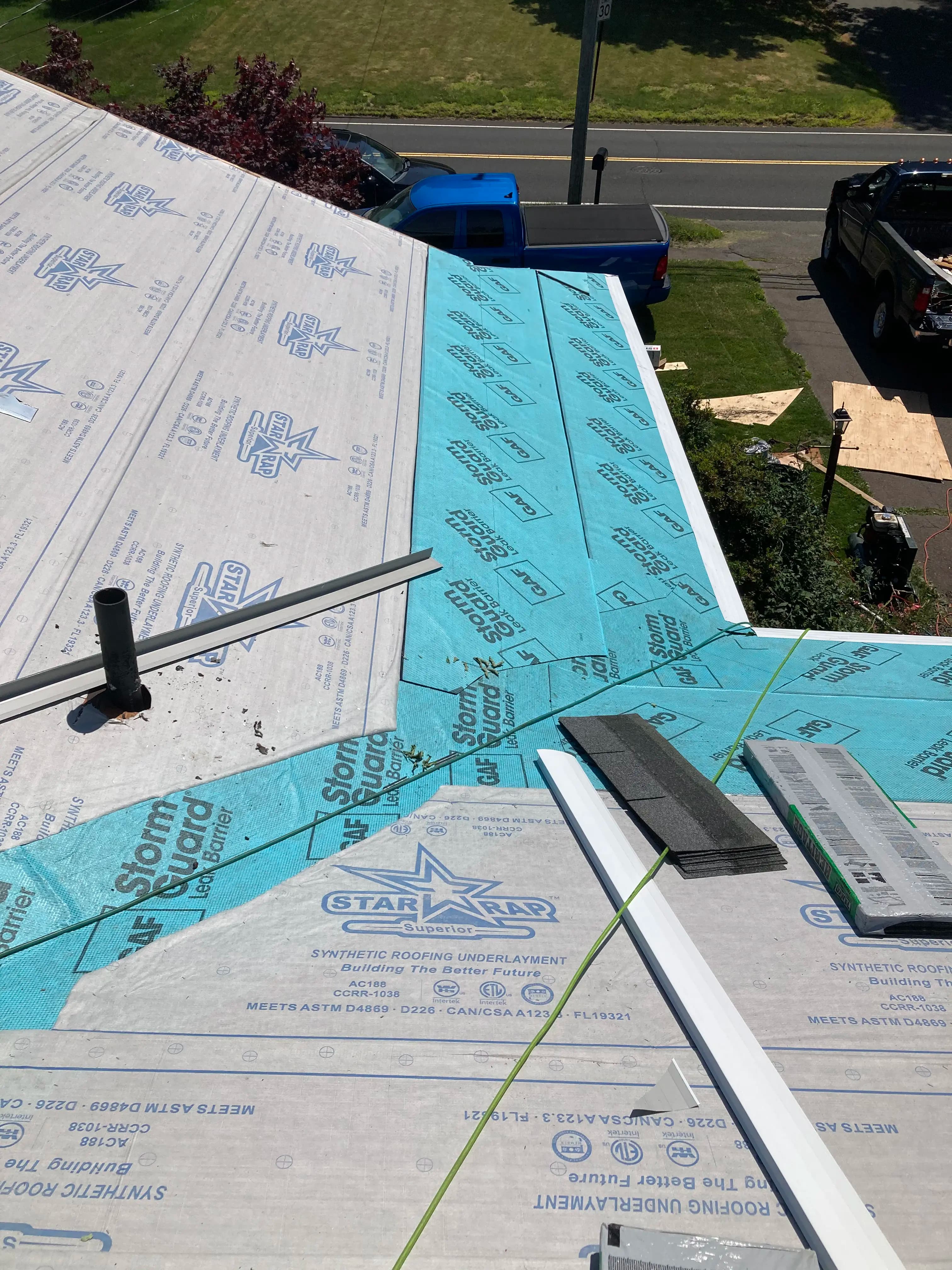
Ice-and-water shield is a self-sealing rubberized membrane that goes on the deck before the shingles. Connecticut code requires one row at the eaves, 24 inches past the interior wall. We install two rows, 48 inches, on every roof, and run it in the valleys too. It doesn't stop the dam from forming, so you'll still see icicles, but it stops the water behind the dam from getting into the house.
Attic insulation and ventilation: fixing the cause
The dam forms because the roof deck is warm. Keep it cold and the snow doesn't melt from underneath: enough insulation on the attic floor, air-sealing around light fixtures and the attic hatch, and ventilation (soffit intake at the eaves, ridge vent at the peak) that keeps cold air moving under the deck. We inspect attic ventilation on every roof we install. If it works, we reinstall the ridge vent; if it doesn't, we build you a better one.
What to do if you have an ice dam right now
Don't hack at it with a hatchet; you'll wreck the shingles. Don't throw rock salt on it. Rake the snow off the lower few feet of roof from the ground if you can do it safely. If water is coming in, call us. We clear snow and ice off roofs (three calls in February 2026 alone, in North Haven, North Branford, and Farmington) and come back when the weather breaks to fix the cause.
What doesn't work
Heat cables are a band-aid that cost money to run and often fail right where the dam forms. A metal roof sheds snow but still dams at the gutter if the attic leaks heat. Gutters don't cause ice dams, but gutters full of October leaves make them worse.
Written by the crew at Pattison Construction, a family-owned general contractor in Wallingford, CT since 1991. GAF Certified Contractor, licensed Connecticut Home Improvement Contractor HIC.0672217. Free estimates, no pressure.